Not everyone should do Contact Improvisation. Not everyone is ready for it. Think about it. Think about what’s at stake. You have to give up your ego. Your sense of control. Your attachment to outcomes. Your social status. Your pride. Your adherence to verticality. Your seclusion. And there’s no guarantee about what any of these might transform into. To choose to do contact is to step out into the unknown with each and every dance.
The first time I saw CI, it seemed so normal, so absolutely reasonable, that it never occurred to me to actually want to try doing it. “Of course,” I thought. “That’s how people should always be with each other.” It wasn’t until later, when I had a crush on someone and followed that person to a CI workshop that I took that step into the unknown.
Why do I continue to practice CI 20 years later? Simple. The ways that I dance — how I use my body, my awarenesses, and my knowledge — are exactly the ways in which I want to live my life. I could probably say the same thing about improvisation in general. After all, the general practice of improvisation already contains a grounded sense of self, spontaneous responsiveness, connection to others, non-attachment to outcomes. But the simple fact of physical contact changes everything, affecting all levels — physical, emotional, sensory, imaginal, kinesthetic, etc. Touch immediately multiplies my engagement in the improvisation by a hundred. And it provides an additional layer of teachings around weight, support, and relationship that improvisation without contact lacks.
In addition, if we are in a practice of cultivating self-awareness for self-transformation, then involving the energy of another human being is one of the fastest routes to change. Working in contact with someone else gives us immediate and living feedback in a way that can be startlingly precise and exquisitely humbling.
When I teach, I strive to cultivate in my students fluency in the Open State of improvisation, body connectivity for efficient and integrated movement, awareness of structural landmarks, released flow, attention to detail, living boundaries, and a sense of how CI connects to their lives.
I continue to find this practice of CI not only fun, but deeply satisfying. When I want to connect with the universe from an expanded sense of self, where I know my tissue might be squished or lifted or flung, where I might possibly have one of those outrageous dances that I’ll remember forever and wonder how I ever survived, then I head to the jam. And I go because I like being affectionate, acrobatic, dangerous, gentle, funny, crazy, and cunning with my friends (and total strangers too).
So don’t do contact, unless you’re ready to lose what’s most important and maybe get something even better in return.
(Text of my full Lightning Talk at Distill 2013, i.e. if it hadn’t been slightly compressed due to imminently reaching my 5 minute limit)
http://www.flickr.com/photos/astroboy/34102978
I want to show you a different kind of technology. [Little improv solo] Got it?
All right, so how many of you speak a foreign language, meaning a different language from your native tongue? Raise one hand for every foreign language you speak, and if you speak more than 2 then twinkle your hands. Okay. Now, how many computer languages do you speak? 1-5 raise one hand, 6-10 raise both hands, more than 10 twinkle.
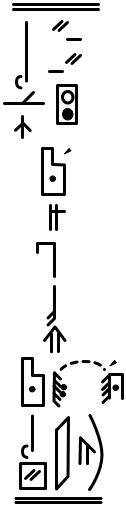
I totally love languages. One of the languages I speak, write, and teach is the language of movement. Written down it looks like this. [*] And here’s that same thing when moved. [Little solo of the slide’s Motif] The written form is called Motif Notation, and it’s used by a small population of choreographers, computer animators, sports coaches, and anyone needing a way to jot down movement. *Any* kind of movement. You want Hip Hop? [*] No problem. Charlie Chaplin? [*] Piece of cake. Boxing knockout? [*] Easy. (That’s a symbol for falling in the upper right, by the way.) And here’s Steve Jobs walking around. [*]
[*] Motif itself is part of a larger system called Laban Movement Analysis, which is a complete conceptual framework for analyzing and working with movement. It can be used descriptively, as in describing what you see or recording it. Or prescriptively, as in optimizing your movement for a particular task, like running or working at a desk or lifting weights or doing yoga.
Think about it. Most of us don’t have a good way to language the movement that we see. How would you describe this? [Tiny solo] Yeah, you’d say, “It’s like he’s doing this… Thing…” Given how precise we are with everything else, it’s pretty funny that we can’t even talk coherently about something as fundamental as our body’s movement.
With Laban Movement Analysis, you get to have that precision. [*] [*] [*] You could describe the movement I just did as stabilizing with the lower body while executing transverse, carving movements with my arms using flow flux and quickness, primarily in the upper kinesphere. That is what you were thinking, wasn’t it?
Distill 2013 Lightning Talk SlidesBut what’s so great about movement? Why should we *care*? Because it’s everywhere. Everything we do, every interaction we have with others involves movement in some way. Even the act of perception is a motor act. If you want to see something, your head turns, and then the motion of the muscles attached to your lenses determines what will actually be in focus.
So, if everything you do is about movement, and you’re able to increase the granularity of your awareness of movement, then suddenly everything you do becomes richer. Like drinking wine after a wine-tasting class. Or listening to Metallica after a course on classical music. You sense more. You feel more. Because you know more. You become a connoisseur of the body. And subtle observations, missed by most people around you, create pleasure.
And you know what mirror neurons are, right? If you watch someone move, then your body has at least a tiny sensation of that same movement just from seeing it. Well, thanks to mirror neurons, you get to experience what others are experiencing too. You’re connected with them across space.
And if you can feel what’s happening inside someone else’s body, it’s harder to do violence against them, because you feel it too. And maybe, if we increase our curiosity about the diversity of ways people operate in the world, we can replace fear with fascination, the need to control with curiosity, and maybe even a little compassion.
Believe it or not, this system began as a project a hundred years ago by a guy named Rudolf Laban. [*] It’s the most comprehensive system of its kind. And yet, most people have never even heard of it. Why?
One big reason is that it currently has very little online presence. Most practitioners don’t blog, don’t Tweet, don’t contribute to Wikipedia, don’t build apps, and suffice to say, don’t have accounts on GitHub. One of my jobs is to try and change all that.
My mission is movement literacy. I’m looking to create the tools and resources so that anyone can learn to read and write movement, and be able to sketch a movement phrase as easily as writing down the melody of a song. [*] I’ve built an app to help visualize movement scales in space, similar to music scales. And right now I’m digging into standardizing a file format for Motif Notation.
I’m working towards a world where people feel strong, smart, and agile in their bodies, and moving through life is delicious.
Exactly one year has passed since my fanciful time travel presentation at Motus Humanus. One year to let thoughts that were emboldened by not being obliged to result in anything but momentary entertainment actually take root and start seeking the light.
I just re-read the transcript of that talk and still stand by what I said — the conceptual and practical developments that could make a difference in the presence and reputation of Laban Movement Analysis (LMA) in the world.
So where are we now? What progress has been made? “Take action. Don’t wait for consensus,” I was told over and over again by various LMA colleagues after that talk. If anything, I would wish to help concretize a process for making change, so that at the very least, we would not be able to say that we were held back by lack of knowledge of *how* to move forward or lack of collaborative tools for doing so.
Here are a few of the digital developments of this past year:
Reed College released a beta version of its iPad-based KineScribe Motif writer. An excellent beginning, with a ways still to go.
Integrated Movement Studies (a.k.a. the West Coast LMA certification program) moved to an experimental one-year program, with an upcoming online component.
New LMA Wikipedia pages were added, instigated by Sandra Hooghwinkel and others.
A number of discussions on some of the most essential issues facing LMA today erupted and subsided on the mailing lists, with indeterminate resolutions.
Exciting stuff. And yet some of the fundamental issues remain, especially around standards and how they (and their variations) are documented. Once again, I challenge those of us who have the privilege of being able to explore and disseminate this system to grab hold of one piece of whatever it is that excites you about carrying it into the future, to a new generation, and run with it.
For my part, I am stepping up to take on these two pieces (and would love help)…
Standards Capture and Versioning
In my talk last year, I named two contexts in which standards needed to be established:
The LMA framework itself
Criteria for certification
At the moment, I’m most interested in the former. Specifically: how might we be able to articulate what LMA consists of?
For starters, I can think of the following categories:
Hands-on interventions (for those programs with a hands-on, touch-based component)
Obviously, suggesting that LMA can be reduced down to lists of individual elements is rather ridiculous, but I think it can provide a starting point for deciding what is and what isn’t part of the system, single terms being easier to start bar fights over than complex, interwoven relationships.
I would love to brainstorm how best to capture the LMA lexicon, document it, and post it publicly. As mentioned previously, I’m leaning toward version control techniques inspired by software development.
And speaking of software, this brings me to my second interest…
Standard File Format for Movement Notation
This is way under-the-hood stuff, but we need a standard, universal file format for encoding movement notations, a universal medium of exchange that would allow any notation written by any program on any device to be read by any other program on any other device that supported the file format.
Innovators could then freely create tools on whatever platform they’re drawn to, knowing that the output of their programs could be read by anyone else. A small thing, but without it, any endeavor risks dying in isolation.
I (and whoever joins me) will undoubtedly look at MusicXML and other digital formats for inspiration.
Your Invitation
There is so much more to be done, and so much room for guiding LMA down the river of these next few years. I hope you will follow your intrigue and your passion, and join me in creating a stable, sustainable, yet ever evolving place for LMA in the world.
And if my particular interests above appeal to you, please contact me directly or leave a comment. We’ll have fun! 🙂
I recently had the honor of presenting at the 2012 Motus Humanus Roundtable. My piece was a fanciful imagining of the state of Laban Movement Analysis (LMA) in the world in 2017, presented as a retrospective of the previous 5 years, and tackling the question of what obstacles had prevented LMA from reaching a larger audience up until 2012. It covered everything from theory, to training format, to Facebook.
Afterwards, Carol-Lynne Moore, president of Motus Humanus, said to me, “That was a juggernaut.” Reading the transcript below, you may well agree.
While my proposals were the result of many weeks of reflection on and discussion about the state of LMA in the world today, my goal was not so much to insist on a particular course of action, as to provide seeds for further discussion and to see, having laid out a number of options, in which direction the inexorable process of change would want to flow.
My outline:
Remembering 2012
LMA in 2017
Observable vs. subjective branches
Alternative lexicons
Notation
Interlude
What made the difference
Online presence
Branding
Authoritative references
Community
Training modalities
Standards
Recap
The Changemakers
So without further ado…
Retrospective from 2017: Technology & the Socialization of LMA
What the heck happened? These last 5 years have been a whirlwind! We always knew it was good stuff, but who could have predicted that Laban Movement Analysis would have exploded in the ways it has into so many facets of society. We’d been waiting for this renaissance for decades and then suddenly it was upon us, like a Strong Free wave, Carving and Spiraling, uniting our species in a new level of awareness.
At this point, I think it’s useful to catch our breath and take stock of what happened. It was no accident. The seeds had been planted years before, but for them to come to fruition, the right forces needed to be set in motion by a courageous few, following impulses that were a mix of common sense and extraordinary vision.
Today, June 9th, 2017, I’d like to take a look at where we were before the renaissance, where we are now, and the specific actions that made the difference, bringing Laban Movement Analysis to its tipping point, the beginning of a new era of embodiment and movement literacy. After my talk, we’ll have a Q&A period, so jot down any questions you have as we go, and bring them up at the end.
Just so you know, I’m not going to cover that crazy period known as the Transverse Times at all, though really, it merits its own entire presentation. I mean, YouTube videos of cats doing scales; Laban porn sites based on the Effort States and Drives… I leave these stories for another day. I’m not going to touch them.
Remembering 2012
Let’s talk about 2012.
It’s probably hard to remember what it was like back then, because so many things have changed. Embodiment was still unknown as a mainstream concept. Most people thought it was a form of demonic possession, or else some kind of plastic surgery. “Buns of steel” and “six-pack abs” were still popular concepts, and though the mainstreaming of yoga was prompting an expansion of the concept of fitness beyond simply strength and cardio, the general public still felt awkward, disconnected from their bodies, and a vague awareness that something vital was still missing.
The body lived a double life, on the one hand exalted in public media in mostly superficial ways that included pushing it to extremes for the sake of adrenaline or entertainment, and on the other hand unacknowledged for its inner richness, for the quiet authority and power it offered if you took the time to listen to it.
In the performing arts, those who should have been closest to an intimate and deep communication with their bodies were still estranged from them. Young actors still mostly thought of themselves as talking heads, with physical action only undertaken to satisfy functional theatrical needs. Training for dancers wasn’t much better. They were mostly taught to mimic idiosyncratic, but for some reason still ballet-based, styles with a minimum of real connectivity training.
What were these people *doing*?
You would have thought that Laban’s work would have been hugely known then. After all, it was and is the *only* comprehensive system in existence for describing human movement with a high degree of granularity. And in the years following World War 2, his ideas had a major influence on movement education in England. Even the great Pina Bausch — moment of silence — could directly trace her movement lineage to Rudolf Laban.
But the fact was: Laban’s ideas were still only practiced by a handful of followers, who were themselves divided into separate groups, each teaching their own version of the system. Clear and consistent standards for certification had not been established. Heck, practitioners couldn’t even agree on the names of the two main notation systems. Was it Labanotation, Structured Description, Kinetography Laban? And was the second one Motif Description? Motif Writing? Motif Notation? Language of Dance?
Actually, it gets worse: they couldn’t decide whether to call him LA-ban or La-BAN. Let’s take a poll: Be honest. Who says LA-ban, raise your hand? Who says La-BAN?
Now *if*, in your college-level dance class of 2012 — you know, the one that you taught — you *actually* had a student who had not only heard of Laban but had studied some of his ideas, I bet you 5 Euros that person was traumatized by notation. I bet they would even agree with using the word “traumatized” to describe their experience. Anyone want to bet against me? [A few hands go up.]
But now, having established that not-so-happy state of affairs, let’s take a look at Laban’s presence, or lack thereof, on the Internet.
Why the Internet? What’s so important about the Internet? Well, unless you’ve been living in a cave for the last 20 years, you know that the Internet has been one of the single most significant technological developments in the last half century. It’s become the de facto standard medium of communication between people across the world and is the single most used portal for accessing information.
However, if you look at LMA’s online presence in 2012, you could pretty accurately say that it was non-existent. If you searched for “Laban Movement Analysis” in Google, the most comprehensive (and according to some, possibly evil) search engine on the planet, you would have gotten back almost exactly half the number of results you’d have gotten by typing in “underwater basket weaving”.
What about blogs? Anyone can start a blog for free and start posting articles there. The collective number of blogs and blog posts about a topic provide a sense of how much community buzz there is around that topic. It represents a kind of social conversation. In 2012, according to some ballpark estimates, there were over 450 million blogs online, written in English, on just about every conceivable subject you could imagine. So how many of these blogs were dedicated to Laban-related activities? Let’s see… Ummm. [Counting on fingers] Three. Ouch.
Okay, forget Google. Forget Bing. Forget blogs. Ah, they’re stupid anyway. Let’s say you really, desperately wanted to learn about Laban Movement Analysis, so you turned to… Wikipedia! Whew, at last some helpful information, even a definition of LMA. But on the other hand, it was just a little surprising to find that the entire LMA system, as known by Wikipedia and apart from its notation, fit on two webpages.
Well, two was better than nothing, and it didn’t matter because in 2012 everyone was busy all the time, so you didn’t want to have to read more than two pages anyway. But now you *did* want to go jump onto Facebook and see which of your friends was talking about LMA.
You were on Facebook back then, weren’t you? Because if you weren’t, you were missing out on where a large percentage of the world was spending their time. In 2012, Facebook had more than 900 million monthly active users. If it were a country, its population would have been almost 3 times the population of the United States. Back then, on average, more than 300 million photos were uploaded to Facebook each day, which comes out to more than 200,000 photos per minute. In one study, students spent between 6 and 10 hours each week on Facebook.
You may or may not have been one of those 900 million users. You might have been a regular poster. You might have been a lurker. You might have objected to the whole concept for any number of reasons, including lack of privacy. But the fact was that a lot of people were spending a lot of time there, and information that people cared about was disseminated far more rapidly than through almost any other means of communication known previously, including email. If you wanted to reach people, you needed to go where the people were. And in 2012, more often than not, that was on Facebook or any of the other large social networks.
That said, the number of Laban-related comments, discussions, and events flying through Facebook airspace was nearly zero.
Looking back at 2012, I think you could say that the main challenge that LMA faced was that it had not positioned itself in a way to reach or foster the next generation of practitioners. It just wasn’t set up to grow. There was little effective outreach beyond the fold of people who were already body-aware. The system needed to find a way to make itself relevant.
LMA in 2017
Fast-forward 5 years. It’s a very different world.
Movement is everywhere. Well, that sounds pretty ridiculous because people were always moving before. But “movement” as a concept, something to talk about, something to start fights in bars about, has taken off. And people aren’t just talking about movement. They’re writing it. With symbols. A report released this year indicates that movement literacy, for the first time, has been achieved in a majority of the world’s population.
We have movement teachers, movement counselors, movement tutors. The standard movement education curriculum now begins with birth and goes all the way through high school. In fact, three of the High Council on the Mars colony went through this exact training.
With the establishment of movement training prerequisites in all major career fields, LMA consultants are highly sought after. Of course, for liability reasons, they are required to be certified, so needless to say, enrollment in cert programs is high. In the States, insurance companies have been some of the most persuasive advocates for widespread movement training. People who move well in their bodies live longer and have fewer accidents.
These companies also funded the invention of zip-on motion capture suits, which have become a standard diagnostic in every household. Family members routinely profile their movements while doing daily tasks to make sure they are moving optimally, and the attached feedback device provides suggestions for making improvements in the form of short Motifs. With heightened awareness of how we all move, a handful of independent designers have created custom lines of clothing, tailored to different movement signatures.
In 2015, Time Magazine named Laban Movement Analysis “System of the Year”, and President DeGeneres declared last year to be the “year of the high-resolution embodied life”.
Meanwhile, the growth of LMA’s presence online has been just as explosive. There are now 235 active blogs dedicated to LMA with thousands of followers. Granted, half of them are sensationalist garbage, and another fourth have no practical value whatsoever. But you have to take the chaff with the wheat, and the remaining blogs consistently post high quality content.
YouTube videos are now accompanied by Motifs of whatever movement appears in the video. Inspired by Pandora, the Movement Genome Project was launched late last year, as a free online tool to help users choose which recreational movement activities they should do, based on their movement tendencies.
The LMA Wikipedia pages have been expanded into a complete chapter of several hundred pages, curated by several moderators. It contains links to the Global Movement Inventory, an enormous collection of video examples of every single and combination cluster of LMA qualities. People regularly submit new samples, which are then categorized by observation committees in weekly Skype conferences. The maintainers of this inventory are right now in discussion with the Lomax Project to migrate over their videos as well.
Clearly, the world has embraced its moving self. And LMA along with it. But what about the system itself? How has it changed? I’ll mention three highlights.
Objective vs. Subjective Branches
As we all know, the biggest theoretical development in recent years has been the division of LMA concepts into two families: Observable and Subjective. Rudolf Laban set out to create a framework for describing movement that would be as objective as possible. His goal was to create a system that would bring the clarity of scientific discernment to the ephemeral phenomenon of movement and allow for inter-observer reliability. For the most part, Laban Movement Analysis, as it was known in 2012, had achieved this goal, and its concepts fell into what we now call the Observable qualities.
We have since acknowledged that the experience of movement contains a subjective component, known only to the mover yet equally powerful and influencing of the movement. This component benefits just as much from a clear and precise vocabulary of description.
For example, when I initiate a Spreading, Scattering motion to Right Side Low with Diminished Bound Flow and Lightness, I also want a way to articulate that I’m responding to an action image — that of scattering my father’s ashes — and an expanded sense of identity — that of feeling my connection to the generations that have gone before me. These internal foci profoundly affect my experience of the movement, though they might be invisible to you. Up until the addition of the Subjective qualities, Laban Movement Analysis gave me no way to language these experiences.
And so, the Subjective vocabulary of description has been developed. Within it, we now recognize new terms: Attention, its quality and location; Impulse Origin, based on Howard Gardner’s theory of multiple intelligences; Identisphere, the size of one’s perceived identity; Sensorisphere, the reach of one’s perceived sensation; and all the rest. Provisions have also been made for re-classifying Subjective qualities as Observable, as our perceptual abilities continue to evolve.
Alternative Lexicons
The second development I want to highlight is the proliferation of alternative lexicons, different words for the same concepts. It was a group of skateboarders in Portland, Oregon, who started the movement. They had been some of the first to jump on the movement literacy bandwagon, mostly due to Thrasher magazine starting to publish Motifs of all its front-cover skateboard moves and creating a free LMA training online targeted at skateboarders. This group in Portland felt that a number of the standard Laban terms weren’t cool enough for the street. They replaced a number of terms, mostly Efforts, with their own, so now instead of a move being Quick, Strong, Diminished Bound, it’s Flash, Grind, Chicken. They also made up new terms that represented common LMA clusters that occur in skateboard moves. Most importantly, they published what they’d done in a series of blog posts that went viral on Facebook, bringing them to the mainstream.
The rest is history. Once people saw they could tweak the terms, different groups came up with alternative lexicons to fit their needs. As Karen [Scherwood] mentioned [in her talk], the golfers use “rhythm” instead of “phrasing”. Obviously, this has made it challenging to find common ground for discussions among the different groups. On the other hand, tailoring the words has allowed these groups to identify more closely with the LMA concepts, and the result has been the spread of LMA into unexpected new demographics. Time will tell whether things become too fragmented, and we need to re-establish some common ground.
Notation
The last significant development to LMA I’d like to mention involves notation.
Movement literacy is now a universally recognized necessity. When I say “literacy”, I’m really talking about two aspects: knowing the conceptual building blocks of movement and being able to write them down. We’ve arrived at the point now where every single concept has a symbol, allowing us to express any LMA idea completely using notation. This is very cool. Why? Because symbols are cool. And powerful.
People everywhere are using movement notation. Choreographers are using it to quickly jot down movement phrases that arise in the creative process and to give movement assignments for the generation of new material. Therapists use notation to catch and record recurring movement patterns in clients. Computer animators use notation in their discussions of animation tools and technologies. Politicians use notation in the margins of their speeches to craft more precise somaticoverbal messages to their listeners.
Notation is everywhere, but one aspect of notation that’s changed is that it’s no longer used to archive dances for reconstruction. At least, not in the way it was done before. To talk about how archiving is done now, we need to first look at the differences between Motif Notation and Labanotation, as they existed in 2012.
Labanotation was created to capture every action of every body part in a movement, a snapshot of the totality. Which made sense, given that one of the goals of Labanotation was to be able to reproduce the movement exactly at a later time.
Motif Notation, on the other hand, was designed to record just the movement highlights, the key events, as interpreted by the notator. Used descriptively, it represented a prioritization of perception. You chose to include some things but not others. Used prescriptively, as a way to dictate the movement that one was supposed to do, it represented a prioritization of intention. Whereas Labanotation indiscriminately recorded everything, Motif Notation told you what to focus on.
Now let’s look at what’s needed for movement archiving, say, for later reconstruction.
As a baseline, we know we need to capture what all the body parts are doing. Pretty obvious, right?
But is that the end of the story? If I told you, a contemporary dancer, that for a given movement phrase, you needed to move your right arm over here with this Effort quality, and your leg over here with this Effort quality… in other words, if I gave you a complete physical description of the movement, would you feel that you could truly inhabit the dance, living it in the same way that its original performer did?
Of course not. To recreate the full experience of movement, you also need to capture the mover’s intention, perhaps a focus on a *particular* body part, or maybe an image, or a feeling.
Clearly, both of these are important: the pure physical description of what the body parts are doing, and the mover’s intention (and attention).
Labanotation used to be the only technology we had to record the former. In conjunction with an expensive, highly trained notator, of course. But now, with advanced video capturing ability built into our very telephones, there simply isn’t any need for using notation to capture the complete inventory of movement events. Three takes with a video camera from different angles, and you’re done, you’re outta there! And you no longer need a notator on the other end either, to go and translate the captured data back into physical movements. You just play the video.
So, for purposes of capturing the purely physical phenomenon of movement, the writing was on the wall, so to speak — notation was no longer needed and no longer practical.
But what about the second aspect of archiving movement — recording the mover’s intention? Here, notation is the *perfect* tool for the job! And guess which notation? Motif Notation. Once the overall movement picture is captured with video, the mover’s intention can be specified using Motif Notation, whose whole reason for existence is to expresses the mover’s focus. And now that Motif has been supplemented with the symbols and grammar of the Subjective branch of LMA, one can easily use Motif to express more poetic, emotional, and even spiritual impulses for movement.
For purposes of archiving movement, we now have a powerful duo: video and Motif Notation, letting each technology do what it does best. And now with holographic video cameras dropping in price, affordable 3D movement capture is just around the corner.
So is Labanotation dead? Not quite. With its main use case gone — that of indiscriminate recording of all movement — it could have vanished. However, a number of people preferred the practical aesthetic of its staff, whose equivalent in Motif would have been required inordinate numbers of body part symbols. So what they did was to prepend the Labanotation staff with the sign for “any body part involvement”, indicating that only key movements would be shown on the staff, not all movements by all body parts. This effectively allowed them to write Motifs on a Labanotation staff. Nice! This looser Labanotation continues to survive, especially among a small sect of Rosicrucian notators living on Vashon Island off the coast of Washington state.
All right. We’ve talked about the current state of the world, on and offline, and noted how LMA itself has evolved, highlighting the *addition* of the Subjective qualities, the development of alternative lexicons, and the rise of video and Motif for archiving.
When you look at where we started in 2012, the gulf between there and here seems enormous. But we all know that the greatest of changes starts with single steps by motivated individuals. Next we’re going to talk about what I feel are the key factors that set the ball rolling in the years following 2012.
Interlude
Playing “Flash Obz”
But first, let’s take a moment of Recuperation. I’d thought we could do a few rounds of one of today’s favorite pastimes among the movement literati. You know what I’m talking about, right? Based on the old-school flash mobs, it’s… “Flash Obz”! (“Obz” for “observation”.) Take out your cellphone.
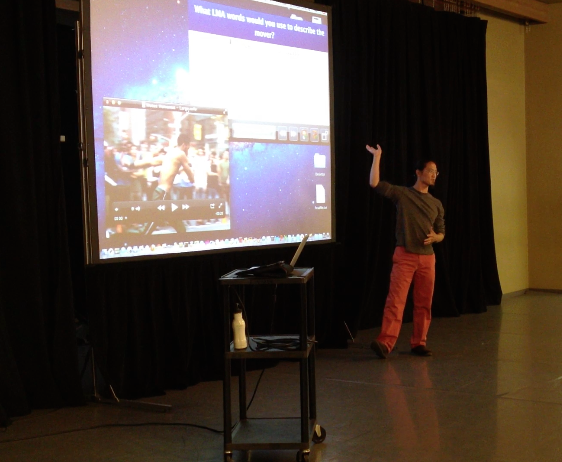
[Next, we watch a YouTube video, and people are given the question: “What LMA words would you use to describe the mover?” They text their answers to a particular phone number, and the words they’ve sent appear in real time on the video screen, courtesy of PollsEverywhere.com. Then, in a separate poll, they answer the following question: “Give an example of movement using Indirect Space Effort”. Their answers to this question are fascinating and will appear in a future blog post.]
What Made the Difference
All right. Welcome back. We talked about 2012. And we discussed where we are now, halfway through 2017. What are some of the key factors that pushed movement literacy and Laban Movement Analysis into the limelight?
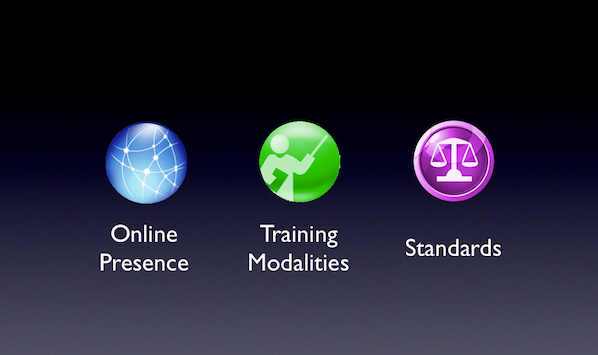
We’re going to talk about three areas: online presence, training modalities, and standards.
Online Presence
“Online presence” can be thought of as the sum total of all the ways that LMA is seen on the Internet, whether on dedicated websites, mentioned in blog posts, listed in Wikipedia, or Twittered, Facebook Liked, StumbledUpon, Pinned, or Google Plussed.
Branding
For our first stop in the discussion of LMA’s online presence, let’s talk about branding. Often reviled by non-marketing people as a foul-tasting word, associated with manipulation and corporate greed, “branding” is simply your online identity, the thing that sets you apart and makes you unique. It’s how you are seen. Everyone portrays themselves in some way. Everyone is seen in some way, whether they like it or not. Go Google yourself and click into the links that pop up. The sum total is how the Internet-browsing world sees you. Are you happy with it? Does it represent you? Have you represented yourself well?
Back in 2012 Laban Movement Analysis had no clear online identity. If you searched for the meanings of terms there were very few references. It was not only unclear what exactly the system was, but also who would want to use it. Part of the problem was that certification programs were still being marketed very generically, trying to appeal to everyone, with the result that only those who were already in the somatic fold were stepping up to enroll.
A new team of graphic designers was hired to revamp LMA’s image, and position it as a contemporary and sophisticated framework. New marketing materials and new websites were created, targeting very specific populations — movement therapists, yoga practitioners, leaders of the change sector, business executives. Each was geared to serve its population best. And the efforts paid off. Interest in the system began to swell and has since hit the ceiling.
Even though different sites portray LMA in different ways, the brand as a whole has become sophisticated. And cool.
Authoritative References
In addition to cleaning up and modernizing its image, LMA also needed a set of online references people could turn to when they wanted more information. The building out of the Wikipedia pages was a perfectly fine start and gave people a relatively trustworthy place to go.
Soon after, other sites sprang up, offering their own definitions of the terms or focusing on aspects of the system less developed on Wikipedia. Or even disagreeing with the Wikipedia references. And this was really just fine. The wealth of viewpoints only increased the amount and depth of online dialogue.
Community
Which brings me to a final aspect of online presence — community.
To foster an online community meant that LMA practitioners had to develop new habits and be willing to reveal more of themselves online.
The various LMA discussions that had previously been taking place on closed mailing lists needed to be opened up to the public and indexable by search engines.
LMA practitioners had to learn how to blog about their observations and curiosities, not as something extra or forced, but as a normal part of their process of exploring and researching LMA. It was a way of routinely logging their insights and experiences. Once people accepted the inherent vulnerability in posting their observations, they found a kind of delight in the fact that nothing they did was wasted. Who knew who would experience an “a-ha” moment when reading their words? In a sense, this community of content generators represented a kind of continually evolving collective knowledge base, documenting its progress along the way in the permanent archives of the Internet.
This new community of Labanistas blogged regularly, created interest groups in Facebook, built tools and apps using newly standardized file formats for representing notation, and through their active, vivacious, fun, insatiable, curious, inquisitive presence online, demonstrated that LMA had social relevance and longevity.
Let’s now look at how people get trained in the system.
Training Modalities
This was the second fundamental shift that helped usher in the Laban renaissance.
Faced with overall declining enrollments and struggling with how to communicate the value of this system to a larger audience, the organizers of the various certification programs asked themselves if perhaps a fundamental opportunity was being missed. One of the great difficulties in marketing the system to the general public stemmed from an inherent strength in the system itself — it was applicable to everyone. But “everyone”, as a demographic, is impossible to reach. In order to grab the hearts and minds of a new generation of practitioners, they needed to limit, not expand, their target population, and what they did next was to reshape how the system itself was being taught.
Recognizing that not everyone was interested in all parts of the system, they took the full two-year certification program and broke it down into the structure we know today: a Core Module, consisting of basic connectivity and movement literacy; and Extensions, which are application-specific modules tailored to the needs of specific practitioners.
In the certification trainings, the Core Module is a two-week, full-time training that everyone takes. It’s the common baseline. And we have sports coaches, dancers, business executives, musicians, process workers… all in the same room, learning the same stuff. Many people report back that this community-building aspect is one of their favorite parts about the core training.
Then we have the Extensions. This is where the depth happens. It’s where practitioners dive into the specific theory and applications of their particular disciplines. Choreographers learn about movement generation, composition, and group dynamics from a Laban perspective. Business executives learn about team building, leadership, and Movement Pattern Analysis, and can opt for a full MPA certification.
The credential one receives specifies the particular extension studied. Just last week, my sister received her CLMA with the Aquatic Sports Extension, and she’s now headed to the Talking Dolphin project in Belize.
By offering Extensions as add-ons to the Core Module, outreach has become a lot easier, as each Extension program can be marketed very specifically, rather than as a one-size-fits-all training. Also, the conciseness of the Core Module allows it to be offered as an in-service, which is now required in many businesses, schools, and hospitals.
Standards
As the Laban renaissance was beginning and the number of opportunities for people to study LMA increased, the question of certification standards arose, and this is part of the third fundamental area that needed to evolve in order for the renaissance to come into full blossom.
When we talk about standards, we mean establishing consistent expectations in two areas: the conceptual framework of the LMA system itself, and the criteria for attaining certification.
But why standardize in the first place? There was a desire by many in the LMA community to present a more coherent and consistent body of work to the world. There had always been certain discrepancies of language and of theory in the various training programs, and these had always co-existed relatively peacefully.
But now, with the socialization of LMA and greater critical inspection by the general public, it was felt that coming together and resolving the differences among the different branches of the system would lead to greater trust in the system and greater adoption, since people would know that the knowledge they gained in any one program could be used anywhere.
The challenge was that the system was continually evolving, and different people liked different versions of the system. Whether because they had been taught a particular version in the past, or because they felt a specific version was closer to Laban’s original intention, or because they simply disagreed with particular changes, the age-old debate between preservation and evolution came to the forefront.
Like any artist, Laban himself had never rested on what he had already done. He was always exploring, re-considering, innovating. But if change was inevitable, how to track what had gone before? How to preserve the state of things and also allow them to develop?
The answer, it turns out, came from the world of software development, where exactly these questions had been pondered and addressed. In software, you have a bunch of programming code which changes over time, and it is vitally important to be able to track exactly what was changed at each step of the way. Sometimes you need to refer to the state of the code at an earlier time. Sometimes a change to the code will break things, and you need to revert back to an earlier version.
In response to these needs, a methodology was developed that allows one to archive the state of the code at any given moment, like taking a snapshot, while allowing development to continue, secure in the knowledge that one can always revisit previous versions.
This is exactly how the Internet standards committee, the W3C, establishes and maintains standards of communication on the Internet. It meets regularly and every now and then publishes new standards, using a new version number.
In 2012, Laban Movement Analysis had none of this. Developments to the system were made occasionally, sometimes in committee, sometimes by individuals, without a formal process of agreeing on changes and without a way to track the system’s evolution. As a result, changes were haphazard and hesitant.
Finally, however, a group of excited volunteers came together in a series of Skype conferences and founded the LSD Consortium, whose initials stood for “Laban Standards Development”. For the first time, a core lexicon, symbols, and grammar, were agreed upon. This was the LMA 1.0 standard, and they published it online in the 6 languages of the United Nations.
Practitioners were invited to use this standard as a basis for their own explorations. At the same time, provision was made for splinter groups to name and even publish their own modifications of the base standard. In the software world, these are called forks. While forks were discouraged due to the possible fragmentation they might cause — everyone doing their own thing — it was acknowledged that full consensus on the standard might not be possible, and so rather than shutting out dissenters, they were given space to formally express their differences.
It turns out that this was a good idea. The whole idea of the Subjective branch of LMA started out as a fork developed by the Moscow Laban community, which was later accepted and incorporated back into the main LMA standard.
Meanwhile, certification standards received the same treatment. A different group was established for this: the SPCA, or “Standard Practices Certification Authority”. As you might imagine, they work very closely and very regularly with LSD, and it’s their job to determine the content of the Core Module and oversee the Extensions. The SPCA hears from the various sub-committees which represent each Extension, and like the standards established by LSD, their recommendations are also maintained in the form of version-controlled, publicly available documentation.
Establishing standards for the conceptual framework of LMA and for its teaching had a profound effect on how LMA was portrayed to the world. It provided solid ground for both educators and practitioners to stand on, and by incorporating best practices from the world of software development, it gave a way to honor and refer to past incarnations of the work, while allowing for LMA’s continued evolution.
Recap
So, we’ve talked about the barren landscape of 2012. We’ve surveyed some of the highlights of what we enjoy today in 2017. Let’s remind ourselves of the 3 main areas in which the Labanistas of 2012 took action to carry the system forward to a new generation.
Online presence: LMA needed to change its image, it needed authoritative online references, and its practitioners needed to go from being online content consumers to content generators. They had to learn to blog regularly, to get active in Facebook and other social networks, and to build the on- and off-line tools that would make LMA useful and fun.
Training modalities: LMA needed to recognize that “one-size-fits-all” usually fits no one, and by re-organizing trainings into a Core Module plus Extensions, it was able to better meet the needs of casual and professional movement aficionados.
Standards: LMA needed to find the common ground among its practitioners, establishing a consistent body of work and pedagogy, and using version control as a tool for evolution.
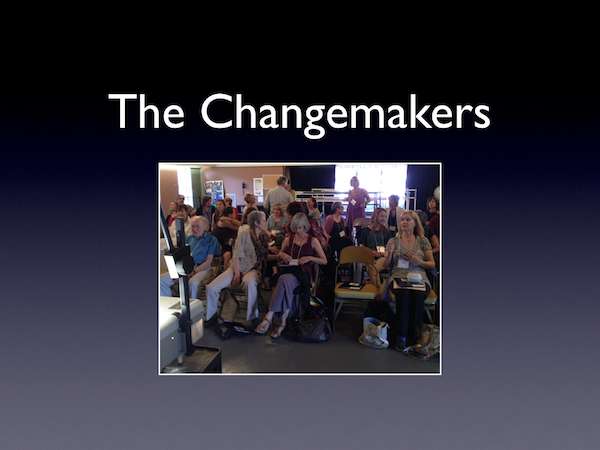
The Changemakers
(Snapped secretly before the presentation)
So, there’s one more little detail. You’ll notice that in order to protect the innocent, I haven’t spoken the names of the instigators of the Laban renaissance.
You know who you are out there. I imagine that you’re secretly harboring the satisfaction of what you created. It was you, wasn’t it, who felt something was missing, something was getting in the way of the world seeing the full power and glory of Laban Movement Analysis. You knew you could be the evangelist of something that would change the world forever. Well, I salute you. We owe the golden age of Laban Movement Analysis to your insight and courage.
Before I open the space up to questions, I’d like to acknowledge Peggy Hackney and Lisa Wymore, for being my sounding board as I was preparing; Barry Blumenfeld, for sharing his work with LoD and kids; and Terese, Teo, and Tessa, whom I abandoned for 4 days to come here.
My contact info is on the screen, if you want to reach me.
In “Impro for Storytellers”, Keith Johnstone says, “The truth is that people come for a good time and nobody cares how the scenes are created except other improvisers… Why should an audience be expected to lower its standards if they know that a show is unscripted? Would a disgusting meal taste better if the waiter said, ‘Ah, but the chef is improvising!’” And yet, when I hear that a performance is being created on the spot before my eyes, a part of me gets excited. Now, it could be a lie, of course, and one could choreograph the illusion that an outcome has not been pre-determined, without detection by the audience.
But when the audience *believes* that performers are risking the act of creation before them, an extra level of engagement comes into play. They identify more strongly with the performers and their choices, and are often more forgiving of perceived mistakes (although this probably depends on each audience member’s attitude towards his or her own making of mistakes). This identification is especially strong if the risk involves making visible decisions and is not simply a test of physical skill. The pleasure of the performance, as an audience member, is then watching your surrogates on stage deal with the situation at hand. On the flip side, there is almost nothing more painful than watching anxious performers struggling and attempting to hide their struggle, shutting the audience out.
With set work, you have the pleasure of watching distilled performance, in which the director has presumably refined raw material down to its most essential, crystalized form.
So, as an audience member, which do you prefer — improvised or set performance? What about as a performer?
Symbols for jamming, created by 2012 Kiev CI festival participants
I just taught an intensive called “Breaking Eggs” at the 2012 Kiev Festival of Contact Improvisation. Along with providing a framework for claiming and then expanding one’s movement patterns, I included a somatic track, consisting of 5 advanced principles that I feel are crucial for articulate, connected dancing. Each one really deserves its own thorough treatment, but for this short intensive, they were simply presented as seeds, to be grown (or rejected) by each participant through the course of his/her own continued exploration.
Here they are…
Five Seeds for Delicious Contact (a.k.a. “Пять семени для вкусной контактной импровизации”):
Shape-shifting through the torso: Having a soft, malleable torso, and allowing it to move in a gradated, proportionate way with every movement of the limbs
Yield-Push: Feeling the moment of emptiness, of sensing, prior to pressing into the earth or your partner
Pelvic propulsion: Using the ricochet from the Yield-Push into the earth to launch the pelvis into movement, ready to follow your partner’s center at a moment’s notice
6 hands, 6 feet: Being able to move your partner via contact with your hands, elbows, shoulders, feet, knees, and/or pelvic halves, especially useful when doing multi-point contact
The eye of the hurricane is calm: Keeping perception fully open, even when the movement becomes fast or complex
(An informal monthly-ish gathering focused on Laban Movement Analysis. Attending: Peggy Hackney, Brenton Cheng.)
Highlights:
Development of standard digital representations of Motif Writing and of Structured Description would pave the way for software designers to create tools that could intercommunicate, even across operating systems. Both tool users and tool developers would benefit. Users would not be locked into using particular tools, because their document files would be portable to other tools and even other computers. Developers would enjoy a lower barrier to entry, as users could immediately open their existing documents within the new tool and would feel less hesitation about being forced to use a proprietary format.
The creation of a standard file format for Motif Writing and for Structured Description would require the coming together of both data schema experts and notation experts.
Since it is theoretically possible to include a section of Structured Description within a Motif and vice versa, perhaps only a single data schema would be needed to support the full range of notation possibilities.
Go to https://listserv.cc.denison.edu/sympa/info/cmalist and click the “Subscribe” link at the left. NOTE: There is currently a bug where a Denison login page is initially shown the first time you go to this URL. But if you re-enter (or re-paste in) the exact same URL, you’ll be taken to the mailing list administration page. UPDATE: The bug was fixed!
(An informal monthly-ish gathering focused on Laban Movement Analysis. Attending: Peggy Hackney, Lisa Wymore, Brenton Cheng.)
Highlights:
When teaching LMA, there are natural affinities between aspects of the system, such that teaching one of those aspects provides the doorway to the other aspect. For example, the Patterns of Total Body Connectivity (whole body movement patterns) can be revealed organically and naturally by starting with Shape Flow Support (shape change in the torso) and allowing the movement to grow. Similarly, working with Kinesphere can lead to Spiral Shape forms, as one changes from Far to Near Reach Kinesphere and vice versa; playing in Near Reach space often wakes up Head-Tail spinal work; and Head-Tail exploration can support a discovery of Indirect Space Effort, if attention is involved.
Starting with Body or Effort often works well when teaching actors, whereas dancers often enjoy starting with Shape.
In Peggy’s book, “Making Connections,” a rich set of images and meanings is associated with each Pattern of Total Body Connectivity. These associations were developed through a combination of personal exploration, developmental physiology, Body-Mind Centering™, and work with clients and students.
What are LMA’s blind spots? Every descriptive system that attempts to be comprehensive names its compass points and accepts that there is territory in between the compass points that cannot be described in a singular way, but only by referencing the compass points around it. This is one kind of “blind spot”. The other kind occurs when a named concept is actually two concepts that have been coupled together. To say that “Shaping”, as taught in the LIMS certification program, always consists of 3D, voluminous movement and also shape-changing through the torso belies the fact that these two aspects of movement can occur independently of one another. In the IMS program, “Shaping” is not taught as a concept, but is instead decoupled into “Carving” and “Shape Flow Support”.
LMA purports to offer a framework for external movement observation, which, supposedly with enough training, provides inter-observer reliability. But within the system, have we inadvertently included concepts which simply can’t and never will be observable from the outside in any consistent way, unless the observers have been trained together using the exact same definitions and movement examples? e.g. Space Effort is currently taught to describe where and how one has placed one’s attention, but is this truly knowable from the outside? And when we talk about being able to read the *intention* of the mover, have we slipped into projection, in such a way that we’ve eliminated the possibility of inter-observer reliability? As a movement observer, I highly value the rich set of subjective experiences that are awakened in me when I observe movement, and they support me immensely in my work. But I question whether they should be part of a system that aims for objective description. Perhaps we could subject each LMA quality to a litmus test — asking ourselves whether the quality is one that a motion capturing machine, now or ever, is likely to be able to discern. In other words, what LMA qualities will *never* be determinable using externally measurable criteria?